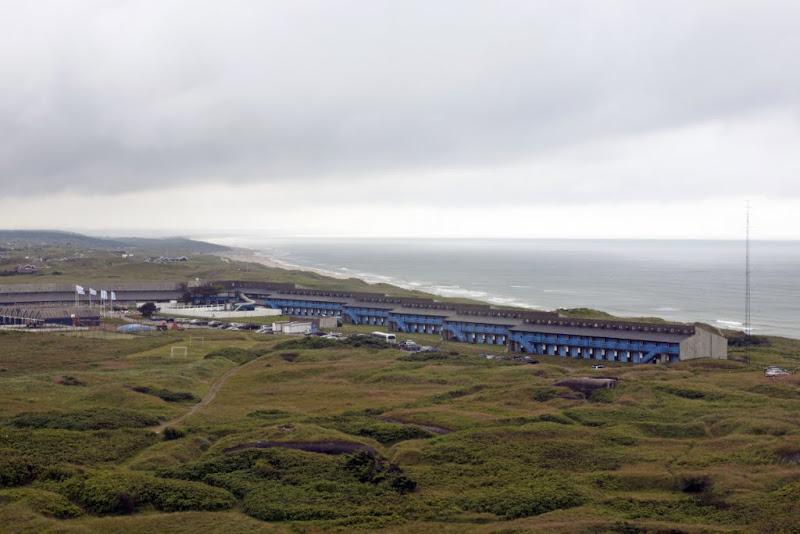
Olen aina rakastanut majakoita. Miksen siis kuvaisi niitä? * I´ve always loved lighthouses. So, why shouldn´t I take photos of them?


© Mari Hirsikallio

Tmi Kameravene Mari Hirsikallio
mari.hirsikallio(at)kymp.net
p. 040 581 7592

- Mikäli kuvat kiinnostavat, ota yhteyttä! Kuvien käyttö ilman lupaani kielletty.
- If you want my photos, please contact! You are not allowed to use my photos without my permission.

2.8.2011

Rubjerg Knude, Tanska / Denmark


The lighthouse tower is 23 metres high, and, when the lighthouse was built, it was 200 metres inland; and there were no large dunes around it.  With time the sea moved in closer, and, simultaneously, the wind blew large amounts of sand up from the cliff.  The sand piled up in front of and around the lighthouse.  It filled the well and ruined the kitchen gardens.

To suppress the sand pine grates were set in and  lyme grass and helmet was planted in the dune.  The only result was that the dune just grew larger.  The more that was planted, the more the dune grew.  At last the sand was so high that at times it was impossible to see the light from the sea.  On August 1. 1968 the struggle was given up and the lighthouse was lit for the last time.

Via www.rubjergknude.dk


Chancing landscape - dynes are growing: the lighthouse and the seasons.


In 1980 the Sand Drift Museum opened, and the lighthouse now was the frame for Vendsyssel Historical Museum’s exhibit on sand and sand drift.  In 1992 the fight against the sand drift was given up.  The dune continued to migrate toward the north east and slowly buried the buildings, and the Sand Drift Museum was closed in 2002.

More: rubjergknude.dk


26.7.2011

Hirtshals, Tanska / Denmark


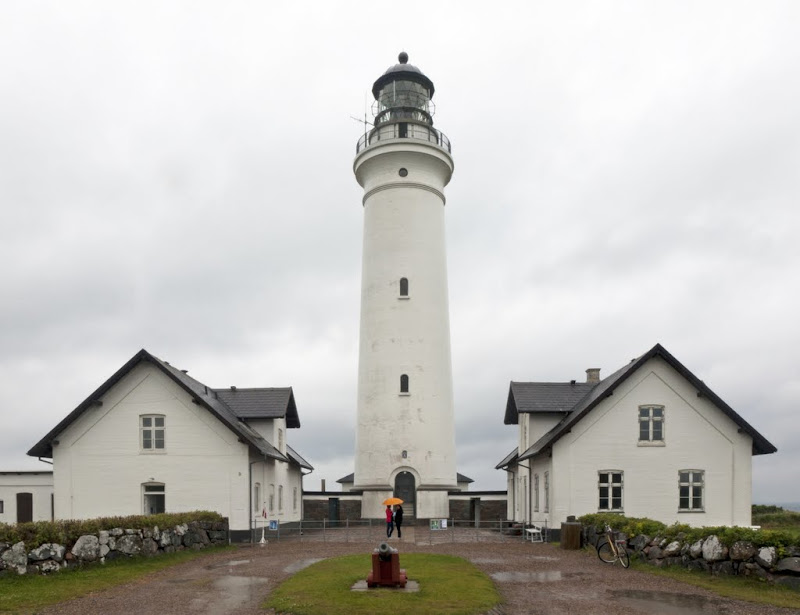
The lighthouse in Hirtshals was built in 1862 and began its working life in January 1863. The architect N.S.Nebelong has drawn the lighthouse. He has 144 steps and it is 35 m high and has a focus height of 57 m above sea level.

The lighthouse all 30 seconds sends a firm white light with a strong flashing sign.

The Hirtshals lighthouse reminds from the construction very much of the Skagen lighthouse. The architect N.S.Nebelong has drawn both towers. On the platform, you have a marvellous view about the town and her area with the Tannisbucht in northern direction and the Rubjerg Knude in southern direction.

Via www.waymarking.com


22.3.2011

Majakkayhteistyötä / lighthouse co-operation

Minua lähestyttiin talvella pyynnöllä Jussarön majakan kuvasta. Viestin kirjoittajan aikomus oli tehdä Jussarön majakasta lamppu. Nyt lamppu on valmis ja yhteistyön tulos nähtävissänne.

Lamppukuvat: Tua Karlsson.


During the winter, I was approached by a request of Jussarö lighthouse pic. The author's intention was to make Jussarö lighthouse lamp. Now the lamp is complete and the results are here.

Lamp Photos: Tua Karlsson.

8.11.2010

Sprogo, Tanska / Denmark


Sprogø is a small, protected Danish island, which is located in the Great Belt, the strait that separates the main islands of Funen and Zealand. It lies about halfway across the strait, 6.7 km from the Zealand shore and 8 km from the Funen shore.


Today, the island forms part of the Great Belt fixed link, and is connected to Funen by a road and rail bridge, and to Zealand by both a road suspension bridge and twin rail tunnels. The island is crossed when using the link. During the construction, the island was drastically remodelled, with land reclamation increasing its area from 38 to 154 hectares.


There are remains of buildings on the original part of Sprogø from the beginning of the 12th century, a fortress built under king Valdemar the Great. During construction work, extensive archaeological investigations were undertaken, and among other findings it was revealed that the first inhabitants arrived more than 8,000 years ago.

The island has no permanent population today, but is used by Sund og Bælt, the company that owns and operates the bridges. It is also a nature reserve, and tours of the island are organised.

A darker part of the island's history are the years between 1923 and 1959, when the island was used for containment of women deemed pathologically promiscuous, the main concern being unwanted pregnancies. At the time it was considered a very humane approach, given the fact that they had previously been confined.

Sprogø was a station for the semaphore line across the Belt, Storebæltstelegrafen, between Nyborg and Korsør, in operation between 1801 and 1865.

The lighthouse, which can be seen in the picture, was built by the mail service in 1868, replacing an older structure from 1809. It was built on the foundations of the 12th century fortress.

Via Wiki.

More (in danish): Sprogo fyr.

1.11.2010

Skagen, Tanska / Denmark


Skagen Lighthouse

Latitude: 57 Deg 43.3 Min N
Longitude: 10 Deg 36.5 Min E
Height of tower: 46 meters
Character: F W
Range: 23 M


The successor of the “White Lighthouse”, with a better location, is the “Grey Lighthouse” who’s official name was just Skagen Light. The architect Professor Niels Sigfred Nelbong (1806 – 1871) was responsible for the way this tower looks. He was a well-known builder of lighthouses, and we can thank him for some of the prettiest Danish lighthouses like Sejeroe, Vesborg, Roesnaes, Hjelm, Hirtshals und Hesseloe and also one of the most ugly, like Romsoe.


He started to design the tower in 1851. The building work itself started in 1854 and took 4 years, which was because the building materials had to be transported by land to Skagen, because there was no harbour yet. On the 1st of November 1858 the tower was first lit. It has the name of King Fredrik VII in the wall. The first years the tower had a fixed light, until a rotating lighting apparatus replaced it in 1905. With a height of 46 meters it was Denmark’s highest tower until 1962. On the bottom the diameter of the tower is 9 m and at the top 6 meters. There are 210 steps to the gallery. The tower is open to the public and you have a great view over the towns of Grenen and Skagen. Together with its predecessor, the white tower, the grey tower forms a nice scene.


The information for all three of these great lights largely comes from a book called “Danmarks Fyrtårne og fyrskibe” by Ove Hermansen and we are grateful to Iris for the help in translating the Danish text.

Via www.lighthouse-duo.net


25.10.2010

Lyngvik, Tanska / Denmark


Lyngvig
latitude 56° 2' 58.9" N longitude 8° 6' 12.5" E


The lighthouse is built on a barrier spit that encloses the Ringkjøping Fjord, which is a large, shallow sound connected to the sea by a narrow inlet. Located at the end of the Holmsland Klitvej in Nørre Lyngvig.


14.6.2010

Söderskär

Sijainti: 60 06,5 N 25 24,8 E
Rakennusvuosi: 1862
Valon korkeus: 37,8 m
Valon kantomatka: 13,5 M
Lisätietoja: sammutettu 1989
Majakan kotisivut: http://www.soderskar.fi/

Ensimmäinen Pellingin lähettyville rakennettu valomajakka rakennettiin 1832 Glosholmin saarelle. Pian majakan rakentamisen jälkeen huomattiin sen sijaitsevan väylältä liian sivussa ja aiheuttavan jopa haaksirikkoja. Uusi majakka päätettiin rakentaa Söderskärin saarelle. Arkkitehti Lohrmanin suunnittelema kuusikerroksinen uusgoottilainen majakka valmistui vuonna 1862. Tornin 8,6 metrinen alaosa oli kiveä ja loppuosa tiiltä. Söderskärin linssilaitteisto oli toinen Suomeen jo 1860-luvulla tilatuista ranskalaisista Fresnelin linssistöistä. Linssilaitteistoa ympäröi lasilyhty, jonka kuparikaton jokaisessa kymmenessä alanurkassa oli pronssiset leijonanpäät. Majakkamestari ja kolme majakanvartijaa asuivat naapurisaarella puisissa asuinrakennuksissa. Vuonna 1957 majakanvartijat poistuivat ja majakka automatisoitiin. Lopulta vuonna 1989 majakka sammutettiin kokonaan.

Via veneily.fi


The neogothic lighthouse tower was built in 1862. Söderskär is the only demolished lighthouse in Finland and the only one that isn’t electrified. The lighthouse is privately owned by Söderskär Majakka Oy. Because it is located on a nature protection area, the access to the lighthouse is limited. More information can be
found on the lighthouse homepage (http://www.soderskar.fi/ Only suomeksi and på svenska). No services.